


LIGHTWEIGHT SLOVENIAN ELECTRIC VEHICLE
The concept outlines the development, production, and testing of a Light Electric Vehicle (LEV) designed for use in urban and rural environments, as well as in carsharing systems, green urban logistics, and other mobility needs. The project aims to support sustainable transportation and reduce environmental and climate impacts. The concept outlines the development, production, and testing of a Light Electric Vehicle (LEV) designed for use in urban and rural environments, as well as in carsharing systems, green urban logistics, and other mobility needs. The project aims to support sustainable transportation and reduce environmental and climate impacts.
The graphic illustrates the environmental burden caused by daily personal car trips in the United States (California). It shows that only 6% of daily trips exceed a distance of 45 miles (72 km). This highlights the potential of a lightweight personal vehicle to meet the full spectrum of everyday mobility needs, while addressing user preferences and maintaining a responsible ecological approach to the environment and climate change.
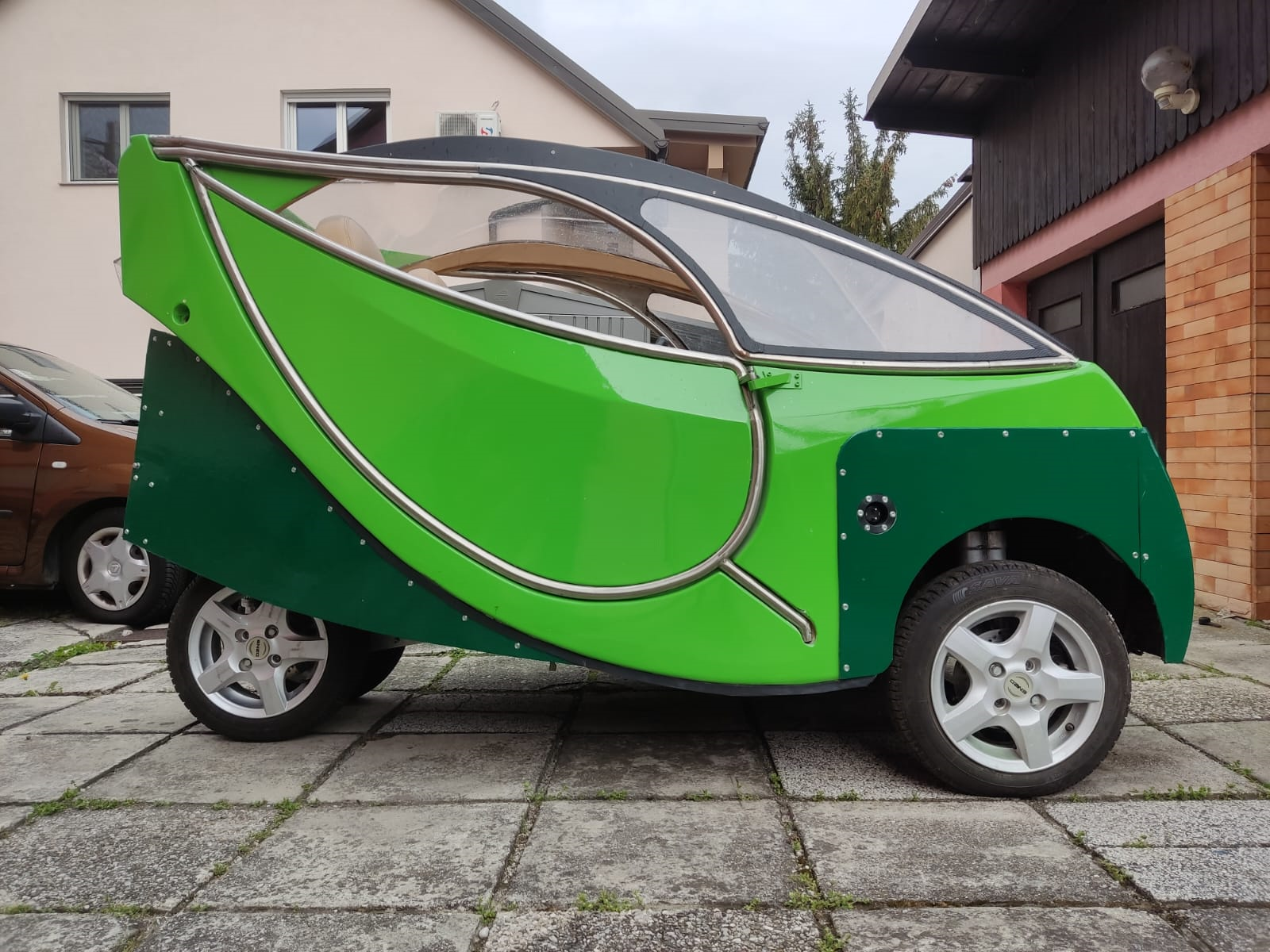
When considering the full range of personal transportation needs, the key factor is the user’s approach to choosing a vehicle. This choice often reflects whether the individual is environmentally conscious or follows an irrational lifestyle focused primarily on status symbols, typically disregarding environmental issues. At present, the balance still leanstoward the latter. The future, however, clearly belongs to ecological solutions—largely due to the increasing environmental awareness of younger generations, who are becoming progressively better educated in sustainability. Additionally, political and government decisionmakers are increasingly active, introducing various fees and restrictions on the use of environmentally harmful vehicles. It is expected that the automotive industry will be required to offer environmentally responsible products based on a minimal carbon footprint (CO₂ emissions). This footprint depends on the amount of “dirty energy” used throughout the entire lifecycle of the product—its manufacturing, use, and disposal—as well as on factors such as vehicle weight, aerodynamics, the efficiency of regenerative energy systems (braking, kinetic recovery), andthe complexity of recycling processes.
Given current production technologies, there is still a significant room for improvement in both design and manufacturing, as today’s solutions generate far more carbon emissions than are actually necessary to transport a person from point A to point B. Another important reality is that the carbon footprint is becoming the key indicator of how environmentally friendly technology is, as well as the only logical and fair basis for calculating future environmental fees.
Highly-skilled, independent professional freelancer.
Gallery


